
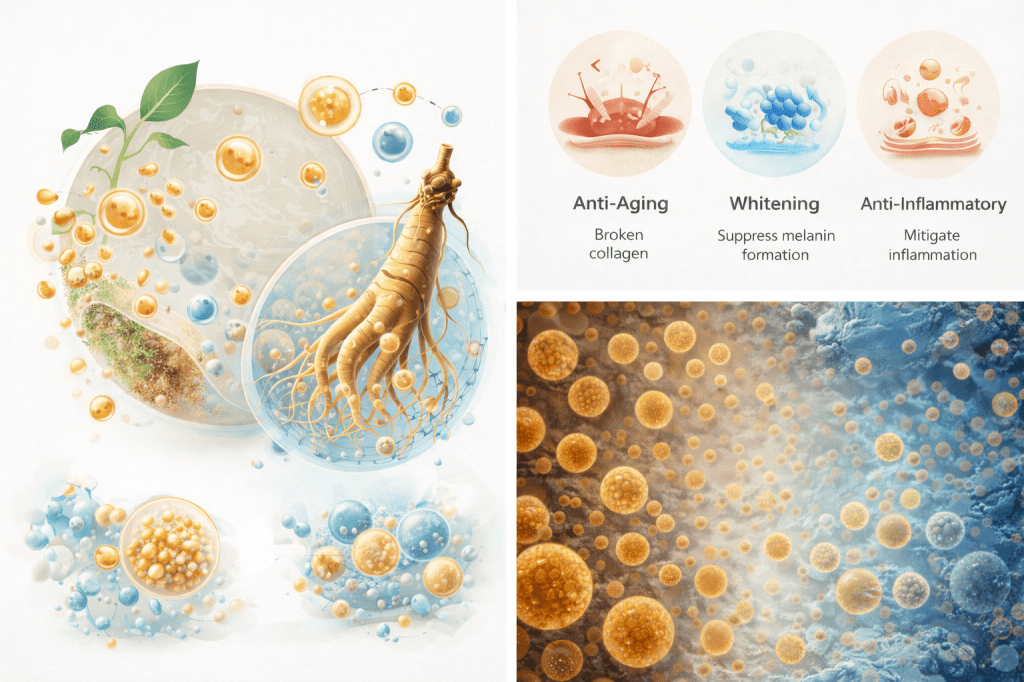
Ginseng-Derived Plant Exosomes and Their Emerging Role in Modern Skincare Science
Advances in skin science have increasingly focused on understanding how cells communicate and respond to their environment. One area that has attracted growing attention is the study of exosomes—naturally occurring extracellular vesicles that serve as carriers of biological signals. These microscopic structures are secreted by living cells and play a role in transporting proteins, lipids, and genetic material between cells, allowing coordinated biological responses to occur. While exosomes were first studied extensively in mammalian systems, recent research has expanded into plant-derived exosomes, opening new possibilities in cosmetic and dermatological formulation.
Plant exosomes originate from plant cells and are involved in internal communication and defense mechanisms within the plant itself. They help plants regulate growth, respond to environmental stress, and protect against external threats. When isolated and studied in laboratory settings, plant-derived exosomes demonstrate structural features that are compatible with human skin, including a lipid bilayer membrane and nano-scale size. These characteristics have positioned plant exosomes as potential delivery systems for botanical bioactives, rather than as conventional active ingredients.
Ginseng, scientifically known as Panax ginseng, has been used traditionally in East Asian cultures for centuries and is widely regarded as a botanical associated with vitality and balance. Historical medical texts describe ginseng as a non-toxic herb suitable for long-term use, often included in traditional formulations aimed at supporting overall wellbeing. Modern phytochemical analysis has identified ginseng as a complex plant containing ginsenosides, amino acids, and various secondary metabolites, many of which are of interest in skin science research.
When exosomes are derived from ginseng through controlled extraction processes, they carry components originating from the plant’s cellular environment. In research settings, these ginseng-derived plant exosomes are studied for how they interact with human skin cells at a cellular level. Rather than acting as surface-level cosmetic agents, their relevance lies in their ability to participate in cellular signaling pathways under laboratory conditions. This distinction is important, as it shifts the focus from immediate cosmetic effects to longer-term biological compatibility and skin support.
Laboratory studies have explored how ginseng-derived plant exosomes influence cellular responses related to oxidative stress, inflammation, pigmentation pathways, and extracellular matrix regulation. These studies are conducted in controlled in-vitro environments and are intended to guide scientific understanding and formulation strategy. As with many emerging technologies in cosmetic science, such findings are not direct substitutes for clinical outcomes but serve as a foundation for further investigation and responsible application.
In the context of modern skincare formulation, plant exosomes are increasingly viewed as part of a biomimetic approach—one that seeks to work in harmony with the skin’s natural structure and function. Their nano-scale size and membrane composition allow them to integrate into advanced formulations designed to support barrier function, skin comfort, and resilience. This approach aligns with a broader movement away from aggressive or overstimulating products toward formulations that prioritise skin balance and long-term stability.
At Shinora, ingredients such as ginseng-derived plant exosomes are evaluated through a lens of scientific responsibility. Emphasis is placed on understanding the biological role of these materials, their formulation compatibility, and their safety profile, rather than on exaggerated claims or rapid results. Plant exosome technology represents a developing field, and its role in skincare continues to evolve as research progresses.
As skin science advances, ginseng-derived plant exosomes illustrate how traditional botanical knowledge and modern cellular research can intersect. By combining historical understanding with contemporary scientific methods, this area of study reflects a thoughtful, measured approach to innovation—one that prioritises integrity, evidence, and long-term skin health over short-term trends.
 SHINORA Health & Beauty
Leave a comment