
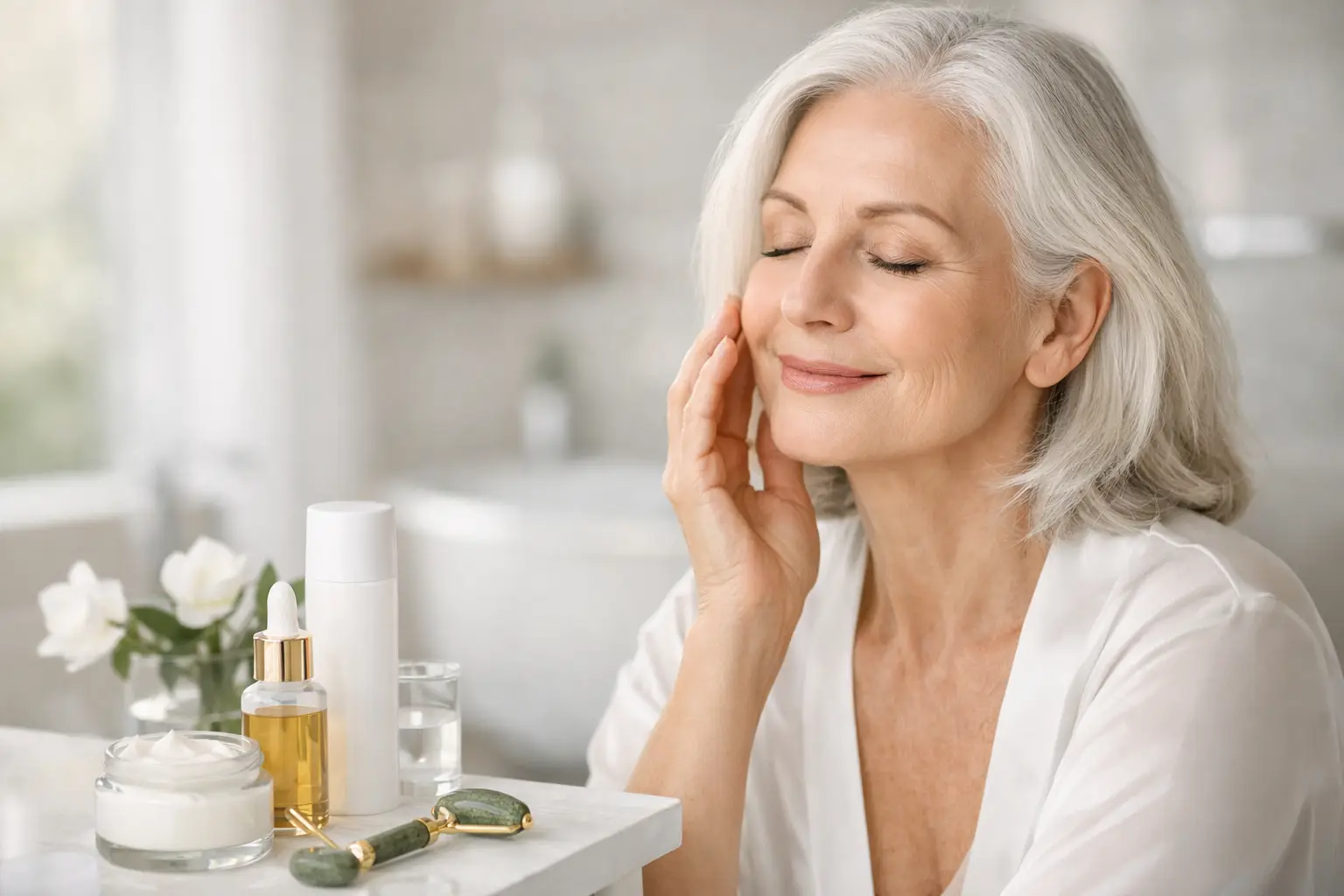
Skin rarely asks for more products. More often, it asks for less irritation, better recovery, and steadier support. A graceful ageing skincare routine is not about resisting time with harsher actives or crowded steps. It is about helping skin stay functional, hydrated, and resilient as its needs shift with stress, environment, hormones, and age.
That distinction matters because mature-looking skin is not defined by wrinkles alone. It is often the result of cumulative pressure – UV exposure, sleep disruption, pollution, dehydration, over-cleansing, and repeated inflammation. Fine lines may be part of the picture, but so are dullness, uneven tone, slower healing, and a feeling that skin no longer bounces back the way it once did. A useful routine responds to those changes with discipline, not drama.
What a graceful ageing skincare routine should do
At its best, a graceful ageing skincare routine supports the skin systems that tend to weaken over time. Barrier function becomes easier to disrupt. Natural lipid levels can decline. Cell turnover may slow. Collagen breakdown gradually outpaces renewal. The result is skin that can look tired even when there is no obvious irritation.
This is why restoration should come before correction. If the barrier is compromised, even well-known actives can become counterproductive. Retinoids, exfoliating acids, and brightening ingredients all have value, but their benefits depend on whether skin can tolerate them consistently. When tolerance is poor, people often mistake irritation for effectiveness and end up with more sensitivity, redness, and dehydration.
A measured routine should therefore do four things well: cleanse without stripping, maintain hydration, protect against oxidative and UV stress, and introduce renewal-supporting actives at a pace the skin can sustain. That is less exciting than a trend-driven regimen, but it tends to produce better skin over time.
The morning: defend and preserve
Morning care should be built around protection. After cleansing, or even just rinsing if your skin is dry and not heavily congested, the priority is to replenish water, support the barrier, and reduce the daily impact of environmental exposure.
A hydrating layer is often the most immediate improvement for skin that looks fatigued. Humectants such as hyaluronic acid and glycerin help bind water into the upper layers of the skin, which can soften the look of fine lines and improve comfort. That effect is not the same as structural anti-aging, but it is still valuable. Well-hydrated skin reflects light better, feels calmer, and is usually more tolerant of active ingredients.
After hydration, antioxidants can be useful, especially for people exposed to urban pollution, long commutes, irregular sleep, or high stress. Vitamin C is the most familiar option, though not every formula suits every skin type. Some people do better with gentler antioxidant blends rather than highly acidic serums. The right choice depends on sensitivity, pigmentation concerns, and how simplified you want the routine to be.
Moisturizer comes next, and this is where many routines fail through underestimating texture needs. Skin that is dehydrated but breakout-prone may still need a substantial barrier-supporting cream, just not one that feels occlusive in a humid climate. Ingredients such as ceramides, squalane, panthenol, and cholesterol can help restore comfort and reduce trans-epidermal water loss without forcing a greasy finish.
The final non-negotiable step is sunscreen. No graceful ageing skincare routine is coherent without daily UV protection. Sun exposure remains one of the clearest drivers of collagen loss, pigmentation, roughness, and visible ageing. If skin care aims to repair but SPF is inconsistent, progress will always be limited. A broad-spectrum sunscreen that you will actually wear every day is more useful than an elegant formula you save for special occasions.
The evening: repair and renew
Night care is where repair-focused skin care earns its place. Evening routines do not need to be long, but they should be intentional. Cleansing matters more at night, especially if you wear sunscreen, makeup, or spend time in polluted environments. The goal is complete removal without leaving skin tight or reactive.
Once skin is clean, think in terms of recovery first and stimulation second. This is especially relevant for adults who have spent years cycling through acids, retinoids, and spot treatments in search of faster change. If your skin is frequently flushed, flaky, or shiny from dehydration rather than oil, barrier work should lead.
A restorative serum can fit well here. Depending on the formulation, ingredients that support repair signaling, calm inflammation, and improve hydration can help skin regain stability. This category may include peptides, panthenol, niacinamide, or more advanced regenerative technologies designed to support the skin’s natural recovery processes. The key is not novelty for its own sake, but whether the formula contributes to resilience.
Retinoids still deserve a place in many routines because they remain one of the more established options for supporting cell turnover, texture, and the appearance of fine lines. But frequency matters. For some, two to three nights per week is more productive than nightly use. Skin that is consistently comfortable will usually age better than skin that is perpetually inflamed in the name of results.
Moisturizer at night can be slightly richer than in the morning, particularly if your skin feels dry in air-conditioned settings or after cleansing. This step helps reduce irritation from active ingredients and supports overnight recovery. In practice, the most effective evening routine is often a cleanser, one treatment product, and a well-formulated cream.
How to adjust for stress, climate, and skin behavior
A routine should respond to conditions, not force the same intensity year-round. This is especially relevant for people balancing travel, indoor cooling, heat, humidity, long workdays, and inconsistent sleep. Skin under chronic stress often becomes more reactive and less predictable. That is not a sign to add more correction. It is usually a sign to simplify.
If your skin suddenly feels tight, dull, or reactive, pause exfoliating acids for a week or two and focus on hydration and barrier support. If breakouts increase, that does not automatically mean you need stronger actives. Dehydrated skin can overproduce oil, while an impaired barrier can make blemishes take longer to heal.
Pigmentation also deserves nuance. Post-inflammatory marks and uneven tone often become more noticeable with age, but aggressive exfoliation is not the only answer. Sun protection, anti-inflammatory care, and patient use of brightening ingredients usually work better than constantly pushing the skin into irritation.
Common mistakes in graceful ageing skin care
The most common mistake is treating ageing as a problem to overpower. That usually leads to too many steps, too much exfoliation, and not enough respect for recovery. Skin does not become stronger by being constantly challenged.
Another mistake is assuming every active ingredient belongs in the same routine. AHA acids, retinoids, benzoyl peroxide, strong vitamin C, and multiple brighteners may all have merit individually, but layering them without a clear reason often creates inflammation that undermines the original goal.
There is also the issue of impatience. A science-led routine tends to look unremarkable in the first week because it is built around cumulative improvement. Hydration can change quickly, but firmness, clarity, and tone usually require months of consistent support. That timeline is not a flaw. It is simply how skin biology works.
A disciplined routine is often a shorter one
For most people, an effective routine does not need more than a cleanser, hydrating or reparative serum, moisturizer, sunscreen in the morning, and one carefully chosen treatment at night. The exact products may vary based on sensitivity, acne history, pigmentation, or how much recovery your skin currently needs. The structure, however, stays fairly stable.
That is the quiet strength of this approach. It makes room for evidence, for patience, and for the reality that skin changes across seasons and life stages. Brands such as SHINORA Health & Beauty speak to this shift well because they frame skin care as long-term support rather than cosmetic urgency.
Graceful ageing is not passive, and it is not perfectionist either. It is the practice of giving skin what helps it function well now, so it can continue to look clear, calm, and alive later. When a routine does that consistently, the results tend to look less like intervention and more like health.


Leave a Reply