
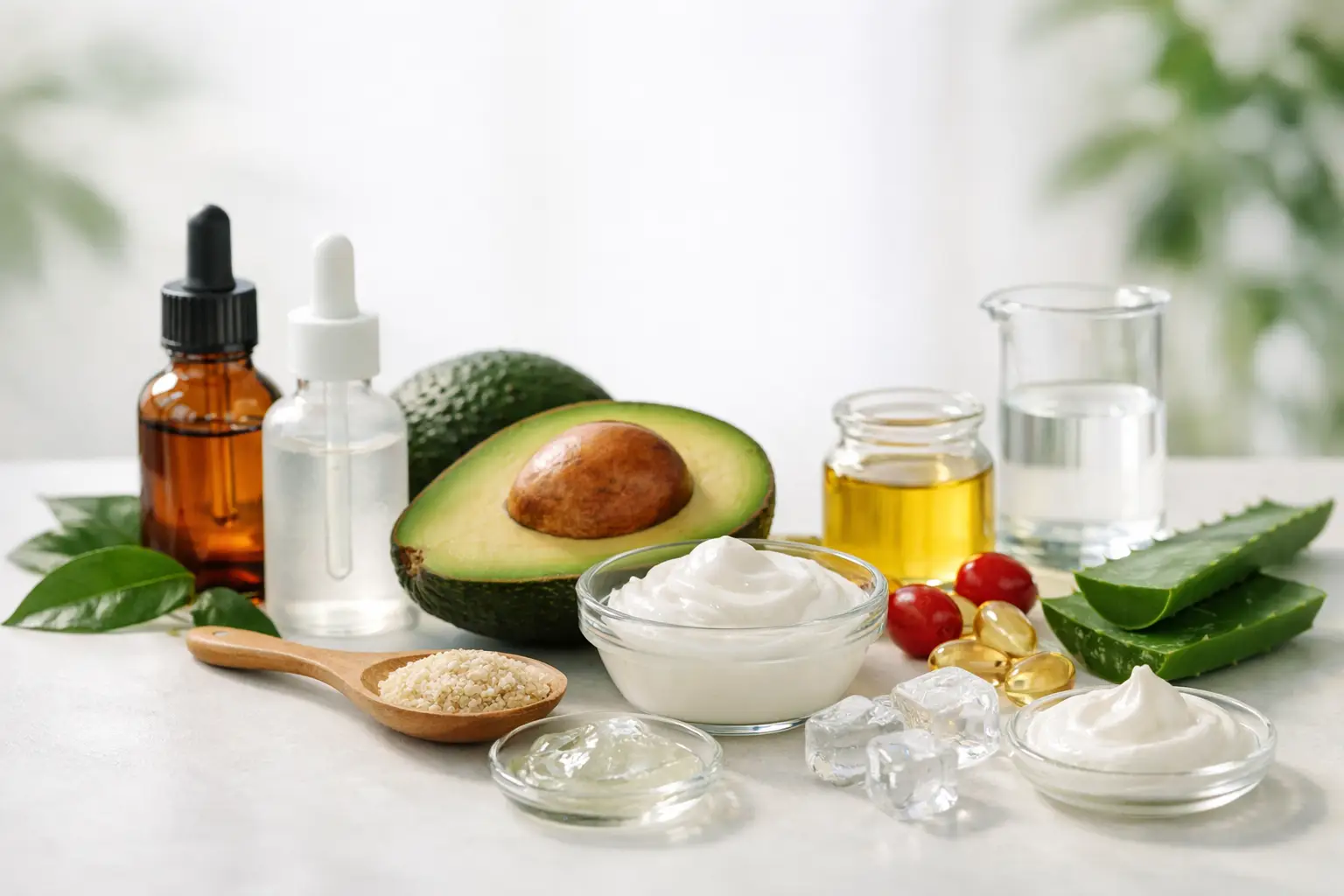
Skin rarely asks for more stimulation. More often, it asks for better support. If you are looking for the best ingredients for skin resilience, the goal is not to force faster turnover or chase a temporary glow. It is to help skin recover well, hold hydration, maintain a stable barrier, and respond more calmly to daily stress.
That distinction matters. Resilient skin is not simply skin that looks smooth on a good day. It is skin that can tolerate environmental shifts, sleep disruption, urban pollution, air conditioning, UV exposure, and the low-grade inflammation that often comes with modern routines. In practice, resilience shows up as fewer reactive episodes, better moisture retention, steadier texture, and a stronger capacity to repair after irritation or breakouts.
What skin resilience really depends on
Skin resilience is shaped by several systems working together. The barrier needs enough lipids to stay intact. Water balance has to be maintained so the skin does not become tight, dull, or easily inflamed. The inflammatory response needs to remain controlled rather than overreactive. And repair processes must function efficiently when skin is challenged.
Age, stress, climate, cleansing habits, overuse of strong actives, and even indoor environments can weaken these systems. This is why a resilient-skin routine often looks less aggressive than many trend-driven regimens. The most effective approach is usually built on ingredients that reinforce structure, hydration, and recovery over time.
Best ingredients for skin resilience
Not every celebrated active belongs in every routine. The best ingredients for skin resilience are usually the ones that improve skin function first, then appearance as a result.
Ceramides
Ceramides are among the most foundational barrier-support ingredients in skincare. They are naturally present in the outermost layer of the skin and help form the lipid matrix that keeps moisture in and irritants out. When ceramide levels are depleted, skin often becomes dry, reactive, rough, or more prone to visible dehydration lines.
Topical ceramides are especially useful for people using retinoids, exfoliating acids, or acne treatments, and for anyone exposed to dry indoor air or frequent cleansing. Their value is not dramatic in the short term, which is exactly why they matter. They support the architecture that healthy skin depends on.
Niacinamide
Niacinamide is one of the most versatile and dependable ingredients for stressed skin. It supports barrier function, helps reduce water loss, and can improve the appearance of uneven tone, excess oil, and post-breakout marks. It also has anti-inflammatory properties, which makes it useful for skin that is easily unsettled.
The nuance is concentration. Higher percentages are not always better. Many people do very well with moderate levels, while stronger formulas can occasionally cause flushing or irritation in sensitive skin. For resilience, consistency often outperforms intensity.
Hyaluronic acid and other humectants
Hydration is often discussed as a cosmetic concern, but it is also a resilience issue. Skin that lacks water becomes less comfortable, less supple, and often more vulnerable to irritation. Hyaluronic acid helps attract and retain water in the skin, improving flexibility and surface smoothness.
It works best when the wider formula also addresses barrier support. Humectants alone can help, but dry or compromised skin usually needs both water-binding ingredients and lipids. Glycerin, panthenol, and sodium PCA also deserve attention here. In many cases, glycerin is the quiet workhorse that makes a formula consistently effective.
Panthenol
Panthenol, also known as provitamin B5, is one of the most reliable ingredients for skin recovery. It helps support hydration, improves skin feel, and is well tolerated by most skin types. It is particularly useful when skin feels overworked, tight, or mildly irritated.
What makes panthenol valuable is its restraint. It does not rely on aggressive resurfacing or visible peeling to prove it is working. Instead, it helps create the conditions under which skin can normalize and repair more comfortably.
Centella asiatica and madecassoside
Centella asiatica, along with its active fractions such as madecassoside, is widely used for calming stressed skin. It is especially relevant for skin dealing with redness, sensitivity, post-inflammatory discomfort, or barrier disruption.
This is a good example of where formulation quality matters more than trend appeal. A well-formulated centella product can support recovery beautifully. A poorly designed one with too much fragrance or too many competing actives may cancel out the benefit. Resilience depends on the whole formula, not just the headline ingredient.
Peptides
Peptides are often associated with aging care, but their role in skin resilience is broader than that. Certain peptides help support the skin’s repair processes and improve the appearance of weakened, tired skin over time. They can be useful when the skin is showing signs of chronic stress rather than a single acute issue.
That said, peptides are not all interchangeable. Some are included at token levels for marketing reasons, while others are more thoughtfully integrated into formulas designed around repair and long-term support. They are most useful when paired with barrier-focused ingredients rather than positioned as a shortcut to dramatic change.
Ectoin
Ectoin remains less widely discussed than some mainstream actives, but it deserves serious attention in conversations about resilience. It is known for helping protect skin against environmental stress and supporting moisture balance. For people living in hot climates, urban environments, or heavily air-conditioned spaces, that matters.
Its appeal lies in its protective profile. Rather than forcing visible resurfacing, ectoin helps skin tolerate the conditions that gradually wear it down. This makes it a strong fit for modern routines where environmental burden is often constant.
Exosomes and advanced repair-focused ingredients
For consumers interested in innovation, exosome-based skincare has drawn attention for its potential role in visible skin repair and recovery support. This is still a category that requires careful interpretation, because quality, sourcing, and formulation standards vary. It should not be treated as a miracle claim.
Still, in well-developed formulas, advanced repair-focused ingredients may complement a resilience strategy by supporting skin that appears fatigued, compromised, or slower to recover. The key is to keep expectations measured. New technology can be promising without replacing the fundamentals of barrier care, hydration, and daily protection.
What matters just as much as the ingredient list
A strong ingredient list can fail in a formula that is too harsh, too fragranced, or poorly balanced. Skin resilience is not built by stacking actives without a plan. It is built by choosing ingredients that work together and by respecting how much stress the skin is already under.
For example, someone managing acne marks may benefit from niacinamide and peptides, but if they are also using frequent exfoliation and a strong retinoid, adding more actives is not always the answer. Sometimes the better decision is to reduce friction, improve hydration, and let the barrier stabilize first.
Climate and lifestyle also shape what resilience looks like. In humid regions, lighter barrier-supporting textures may be enough. In dry indoor environments or during travel, richer ceramide-based products may become more important. Skin does not respond to ingredients in isolation from the conditions around it.
How to choose the right resilience-supporting routine
The most effective routine is usually simpler than expected. Start with a gentle cleanser that does not leave the skin tight. Follow with a treatment or serum built around one or two repair-oriented ingredients such as niacinamide, panthenol, centella, peptides, or hyaluronic acid. Then use a moisturizer that reinforces the barrier, ideally with ceramides or similar lipids.
During the day, sunscreen remains essential. No discussion of resilience is complete without it. UV exposure steadily undermines the skin’s capacity to maintain collagen, manage inflammation, and repair itself well. Even the best restorative ingredients have limited value if the skin is repeatedly exposed without protection.
If your skin is reactive, resist the temptation to test multiple new products at once. Introduce one formula, give it time, and watch for signs of improved comfort, reduced redness, more consistent hydration, and better recovery after stress. Progress in resilient skin is often subtle at first, then cumulative.
At SHINORA Health & Beauty, this kind of measured approach reflects a simple truth: skin tends to respond well when care becomes more intelligent, not more aggressive.
A better question than what is trending
When evaluating any product, it helps to ask not whether the ingredient is popular, but whether it helps skin function better under real conditions. Does it strengthen the barrier? Improve hydration? Reduce reactivity? Support recovery without creating new stress?
Those questions usually lead to better choices than trend cycles do. Resilient skin is not built through constant escalation. It is built through steady support, thoughtful formulation, and the patience to let repair do its work.

Leave a Reply