
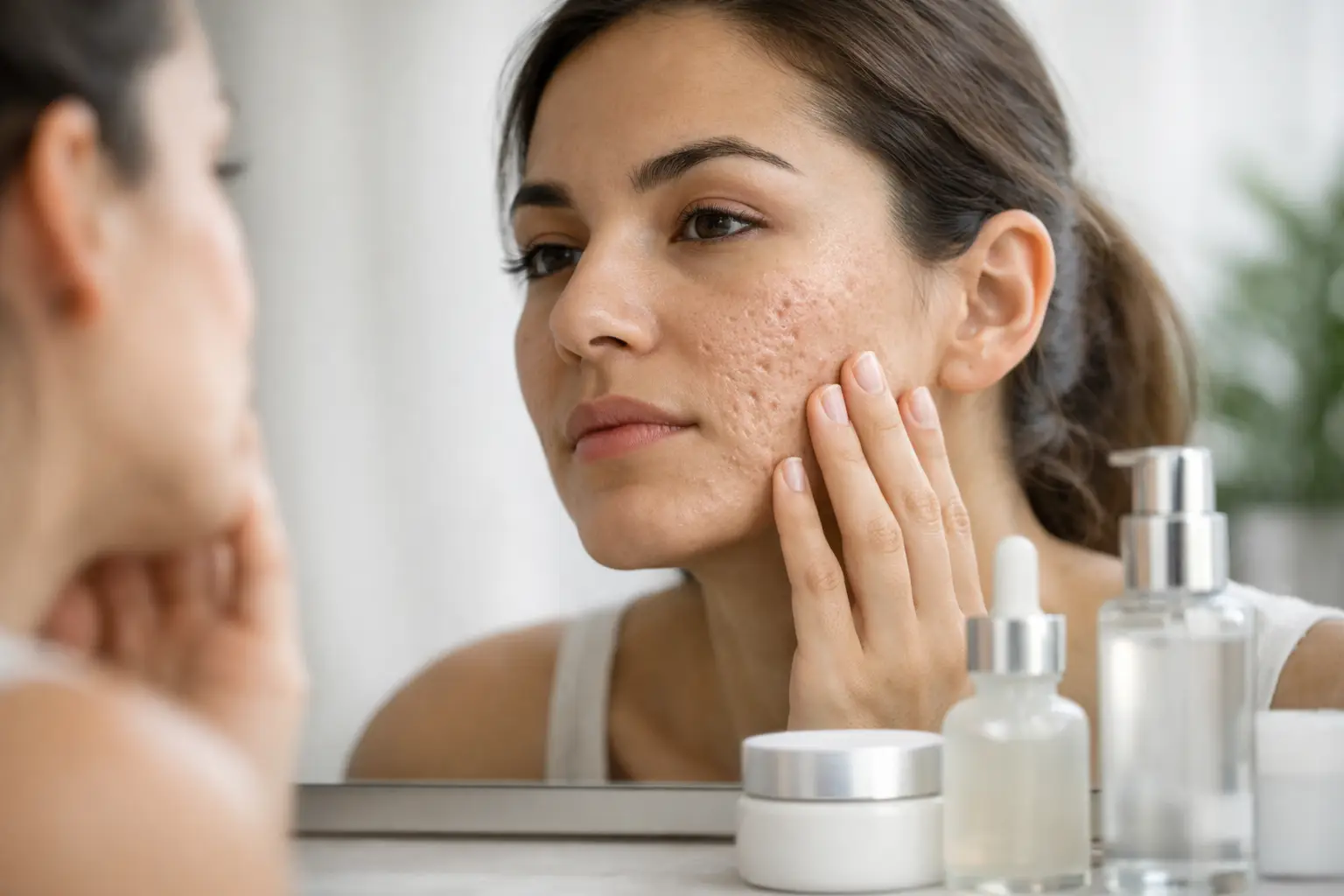
When a breakout has passed but the skin still holds onto its memory, the question becomes more specific: can skincare help acne scarring, or is this something only procedures can change? The honest answer is yes, but with limits. Skincare can meaningfully improve the appearance of certain post-acne marks and support a healthier healing process. It is less effective for deeper structural scars, where the skin’s architecture has already been altered.
That distinction matters because many people use the word scarring to describe several different concerns at once. Some are dealing with post-inflammatory hyperpigmentation, which appears as brown or gray marks after inflammation. Others have post-inflammatory erythema, the pink or red traces that linger after acne has healed. Then there are true acne scars, such as ice pick, boxcar, and rolling scars, which involve a loss or disruption of collagen in the skin. Good skincare can help all of these to some degree, but not in the same way and not to the same extent.
Can skincare help acne scarring or just fade marks?
Skincare is often most effective when the concern is discoloration rather than texture. Dark marks and residual redness can gradually improve with topical ingredients that regulate pigment, reduce inflammation, and protect the skin from further damage. This is where a consistent routine can make a visible difference over time.
True acne scars are more complex. When acne has damaged deeper layers of skin, leaving depressions or uneven texture, a serum or cream cannot fully rebuild that lost structure on its own. That does not make skincare irrelevant. It can still support collagen function, improve skin quality, soften the look of unevenness, and prepare the skin to respond better to professional treatment if that becomes necessary later.
So the useful question is not whether skincare can erase acne scarring. It is whether skincare can improve the skin’s condition enough to reduce visibility, support repair, and prevent scarring from becoming more pronounced. In many cases, it can.
What skincare can realistically do for acne scarring
A disciplined routine helps in four main ways. First, it reduces ongoing inflammation. Acne that continues to flare creates repeated injury, which increases the chance of marks and scars becoming more persistent. Second, it supports barrier repair, which is essential if the skin has been weakened by over-exfoliation, harsh acne products, or environmental stress. Third, it can encourage more even skin tone and a smoother surface appearance. Fourth, it helps maintain hydration, which improves how the skin reflects light and often makes textural irregularities look less obvious.
This matters particularly for adults balancing breakouts with dehydration, sensitivity, or early signs of aging. Aggressive treatment can sometimes worsen overall skin quality, leaving the complexion dry, reactive, and more visibly fatigued even if blemishes are reduced. A repair-focused approach is often more sustainable.
Ingredients that can help
Retinoids remain one of the most studied topical options for post-acne concerns. They increase cell turnover, help normalize keratinization, support collagen production, and can improve both pigmentation and fine textural irregularity over time. Progress is usually gradual, and tolerance matters. Irritation can delay consistency, which is why lower-strength or well-formulated retinoid products often perform better in real life than overly aggressive use.
Exfoliating acids also have a place, but they require restraint. Salicylic acid can be useful for acne-prone skin because it works within the pore and helps reduce congestion. Alpha hydroxy acids such as glycolic or lactic acid can improve surface texture and brightness. Used too often, however, they can compromise the barrier and increase inflammation, especially in skin already managing post-acne sensitivity.
Niacinamide is a strong option for a more balanced routine. It supports barrier function, helps regulate oil, reduces visible redness, and can gradually improve uneven tone. For many people, it is one of the most practical ingredients because it fits easily into daily care without creating unnecessary stress on the skin.
Azelaic acid is another thoughtful choice, especially for those dealing with persistent marks, redness, and active breakouts at the same time. It has anti-inflammatory and pigment-modulating properties and is generally well suited to routines that prioritize steady improvement over rapid irritation.
Vitamin C can be helpful for post-inflammatory pigmentation and overall brightness, though formulation quality matters. Some forms are more irritating than others, and not every skin type tolerates a low-pH formula well. In those cases, gentler antioxidant systems may be the better long-term choice.
Hydrating and restorative ingredients deserve equal attention. Hyaluronic acid, glycerin, ceramides, panthenol, and peptides help maintain resilience and recovery. Skin that is calm and well hydrated often looks clearer, smoother, and more even, even before deeper changes have fully developed.
Why sunscreen matters more than most people expect
If acne marks are your concern, sunscreen is not optional. UV exposure can deepen post-inflammatory hyperpigmentation and prolong visible redness, even when the sun does not feel especially intense. For people in climates with frequent heat, humidity, and year-round UV exposure, this becomes even more relevant.
Daily broad-spectrum protection helps preserve any progress made by brightening or reparative ingredients. Without it, the skin can remain trapped in a cycle where marks fade slowly or return easily. This is one of the least dramatic parts of a skincare routine, but often one of the most important.
Where skincare reaches its limit
Skincare has clear boundaries. Deep ice pick scars, pronounced boxcar scars, and tethered rolling scars usually involve structural changes beneath the surface. Topicals cannot lift an indented scar in the same way that procedures such as microneedling, subcision, fractional laser, or chemical reconstruction techniques may be able to.
There is also the matter of time. Even when skincare is working well, improvement tends to unfold over months rather than weeks. That pace can feel slow, especially when marketing language has trained consumers to expect visible transformation almost immediately. Skin repair is rarely linear. Some marks fade quickly, others linger, and texture tends to change more slowly than tone.
This is why realistic expectations are protective. They help prevent the common cycle of product-hopping, overuse, and irritation that often leaves skin looking worse rather than better.
A smarter routine if acne scarring is the concern
If your skin is showing both active breakouts and lingering marks, the best routine is usually not the most complex one. Start by controlling inflammation and preserving the barrier. A gentle cleanser, a targeted treatment such as retinoid, azelaic acid, or niacinamide, a restorative moisturizer, and daily sunscreen are often more useful than stacking multiple strong actives.
If texture is the main concern, patience becomes even more important. A routine built around collagen support, hydration, and measured exfoliation can improve overall skin quality, even if it does not remove deeper scars. That improved baseline often makes professional treatment decisions clearer later on, because the skin is calmer and more resilient.
For those with sensitive or stressed skin, less can be more. Environmental exposure, lack of sleep, and chronic stress can all influence healing and inflammation. Skincare cannot fully offset these pressures, but it can reduce the additional burden created by over-treatment. This is where a restorative philosophy is especially valuable. Brands such as SHINORA Health & Beauty are aligned with this more disciplined approach, focusing on recovery and long-term skin function rather than chasing irritation in the name of speed.
Can skincare help acne scarring in the long term?
Yes, especially when the goal is visible improvement rather than perfection. Skincare can fade post-acne marks, reduce redness, support collagen, improve skin texture at the surface level, and help prevent future scarring by keeping acne and inflammation better controlled. It cannot replace every in-office treatment, and it should not be expected to reverse deep structural scars alone.
Still, that does not diminish its value. Good skincare changes the context in which scars are seen. It can make the skin healthier, more even, and more resilient. It can also help you move away from a cycle of correction and toward a steadier process of repair.
If you are deciding where to begin, begin with consistency. Not intensity, not excess, and not the latest promise. Skin that has been through inflammation usually responds best to care that is calm enough to be repeated, and intelligent enough to respect how recovery actually works.

Leave a Reply