

When supporting an adolescent with excess weight, the number on the weighing scale is only one part of the picture.
A meaningful weight-management assessment should also consider whether the change comes mainly from body fat, muscle or other fat-free tissue. In this anonymised Shinora case observation, a boy aged 12 at baseline recorded encouraging changes in several body-composition measurements over approximately 16 weeks.
During the monitoring period, his recorded routine included:
- Liposure: two sachets daily
- Glusure: taken before high-carbohydrate meals
This was the regimen used in this individual case. It should not be interpreted as a general dosage recommendation for all children or adolescents.
Case Overview
The initial body-composition assessment was performed on 14 May 2026, and the follow-up assessment was conducted on 3 September 2026.
The total monitoring period was 112 days, or approximately 16 weeks.
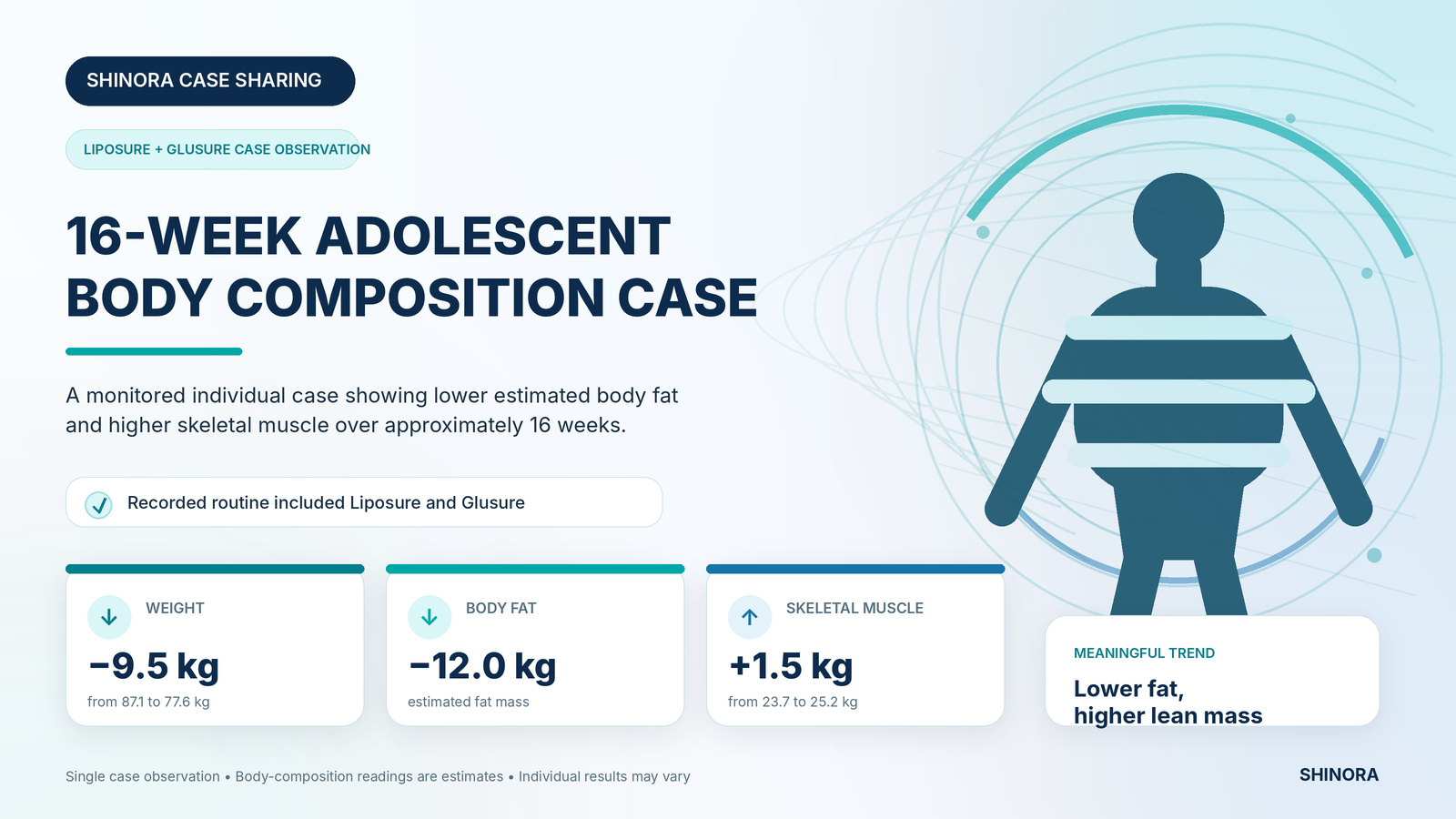
At baseline, the boy weighed 87.1 kg. At follow-up, his weight had decreased to 77.6 kg.
More importantly, the body-composition results suggested that the reduction was predominantly from estimated body fat, while skeletal muscle and overall fat-free mass increased.
Before-and-After Body-Composition Results
| Measurement | 14 May 2026 | 3 September 2026 | Recorded Change |
|---|---|---|---|
| Body weight | 87.1 kg | 77.6 kg | ↓ 9.5 kg |
| Estimated body-fat mass | 43.4 kg | 31.4 kg | ↓ 12.0 kg |
| Body-fat percentage | 49.8% | 40.4% | ↓ 9.4 percentage points |
| Skeletal muscle mass | 23.7 kg | 25.2 kg | ↑ 1.5 kg |
| Fat-free mass | 43.6 kg | 46.2 kg | ↑ 2.6 kg |
| Visceral-fat index | 16 | 13 | ↓ 3 |
| Waist-to-hip ratio | 1.11 | 0.98 | ↓ 0.13 |
| Estimated basal metabolism | 1,311 kcal | 1,367 kcal | ↑ 56 kcal |
A 9.5 kg Reduction in Body Weight
Over the approximately 16-week period, body weight decreased from 87.1 kg to 77.6 kg.
This was a reduction of:
- 9.5 kg in total body weight
- Approximately 10.9% of the starting body weight
Although this degree of reduction is notable, the body-composition pattern is more informative than the weight change alone.
Estimated Body-Fat Mass Decreased by 12.0 kg
Estimated body-fat mass decreased from 43.4 kg to 31.4 kg, representing a reduction of 12.0 kg.
The estimated body-fat percentage also decreased from 49.8% to 40.4%, a reduction of 9.4 percentage points.
This means the recorded reduction in estimated fat mass was greater than the total reduction in body weight. The difference can be explained by the simultaneous increase in fat-free mass recorded during the follow-up period.
Muscle and Fat-Free Mass Increased
A common concern during weight reduction is the possibility of losing muscle together with body fat.
In this case, the opposite trend was recorded:
- Skeletal muscle mass increased by 1.5 kg
- Fat-free mass increased by 2.6 kg
- Estimated basal metabolism increased from 1,311 to 1,367 kcal
Taken together, these measurements suggest a favourable body-recomposition pattern: estimated body fat decreased while lean tissue was maintained and appeared to increase.
The increase should nevertheless be interpreted in the context of normal adolescent growth and the limitations of body-composition analyser estimates.
Improvements in Central-Fat Indicators
The body analyser also recorded improvement in two indicators related to central fat distribution.
The visceral-fat index decreased from 16 to 13, while the waist-to-hip ratio decreased from 1.11 to 0.98.
These changes support the overall pattern seen in the other measurements: lower estimated body fat alongside improved body composition.
They should be viewed as monitoring trends rather than stand-alone medical diagnoses.
How Liposure and Glusure Were Used in This Case
Liposure
Liposure was taken at a recorded amount of two sachets daily during the monitoring period.
Glusure
Glusure was taken before meals expected to contain a larger carbohydrate load.
The products were included as part of this individual’s routine. This case did not include a control group and was not designed to isolate the effect of either product.
Therefore, it cannot determine how much of the observed change resulted from Liposure, Glusure, food choices, physical activity, normal growth, family support, adherence, sleep habits or other factors.
Why This Case Is Encouraging
This case is encouraging because the observed improvement was not limited to a lower number on the weighing scale.
The recorded pattern included:
- Lower total body weight
- Substantially lower estimated body-fat mass
- Lower body-fat percentage
- Increased skeletal muscle mass
- Increased fat-free mass
- Lower visceral-fat index
- Improved waist-to-hip ratio
Within the rounding limits of the measurements, the reduction in estimated fat mass and increase in fat-free mass largely account for the change in total body weight.
This suggests that the boy’s body-composition trend moved in a more favourable direction over the follow-up period.
Adolescent Weight Management Is Different From Adult Slimming
Children and adolescents are still growing. Their weight should therefore not be interpreted using adult standards alone.
For people aged 2 to 19 years, BMI should be interpreted according to age- and sex-specific BMI-for-age percentiles, together with medical history, physical findings and other relevant health information.
For this reason, this article focuses on the directly comparable body-composition measurements rather than applying adult BMI categories.
Professional paediatric guidance also emphasises that adolescent obesity care should be child-focused, family-centred and coordinated. Nutrition, activity, behaviour, emotional well-being and the involvement of parents or caregivers all remain important parts of a comprehensive programme.
Regular physical activity should also form part of a healthy adolescent routine. The World Health Organization recommends that children and adolescents aged 5 to 17 years accumulate an average of at least 60 minutes of moderate-to-vigorous physical activity daily across the week, with age-appropriate muscle- and bone-strengthening activities included regularly.
What This Case Can—and Cannot—Tell Us
This case demonstrates an encouraging association between the monitored programme and improved body-composition measurements.
However, it does not prove that Liposure and Glusure alone caused the changes.
A single individual case cannot:
- Establish product efficacy
- Predict the results of another person
- Exclude the influence of diet, activity or normal growth
- Replace a controlled clinical study
- Replace professional medical assessment
Body-composition analyser results are estimates and may also vary according to hydration, recent meals, physical activity and measurement conditions. Serial measurements are most useful when they are performed under reasonably consistent conditions and interpreted as trends.
A Responsible Approach for Anyone Below 18
Weight management in a young person should focus on health, function, confidence and sustainable routines—not shame or appearance.
Before any person below 18 years old begins a weight-management product or programme, there should be:
- Parent or guardian involvement
- Assessment by an appropriate healthcare professional
- Review of growth and development
- Consideration of medical conditions and current medications
- A balanced and adequate nutritional plan
- Regular monitoring for tolerance and progress
Products should be considered only as possible adjuncts to a broader, professionally guided plan—not replacements for nutritious meals, physical activity, adequate sleep or appropriate medical care.
Conclusion
Over approximately 16 weeks, this adolescent case recorded:
- 9.5 kg lower body weight
- 12.0 kg lower estimated body-fat mass
- 9.4 percentage points lower body-fat percentage
- 1.5 kg higher skeletal muscle mass
- 2.6 kg higher fat-free mass
- Improvements in visceral-fat index and waist-to-hip ratio
The most encouraging feature was not simply the reduction in total weight. It was the recorded pattern of lower estimated body fat together with increased muscle and fat-free mass.
This represents meaningful progress in this individual case. Nevertheless, results differ between individuals, and no similar result can be guaranteed.
For information about Shinora Liposure and Glusure, please contact Shinora. For an adolescent, product suitability and the overall weight-management plan should first be discussed with a healthcare professional and the parent or guardian.
Frequently Asked Questions
Did Liposure and Glusure alone cause the results?
This cannot be concluded from a single case. The products were included in the boy’s routine, but the results may also have been influenced by food intake, physical activity, family support, natural growth, adherence and other factors.
Why is BMI not included in the main comparison?
BMI in children and adolescents should be interpreted using age- and sex-specific BMI-for-age percentiles rather than adult BMI cut-offs. It should also be considered together with the child’s overall growth pattern and clinical assessment.
Are similar results guaranteed?
No. This is an individual case observation. Every person responds differently, and the outcome should not be presented as typical or guaranteed.
Can children or teenagers take Liposure and Glusure?
Anyone below 18 years old should only use a weight-management product after an individual assessment by a qualified healthcare professional and with parent or guardian involvement.
Is losing weight the only goal?
No. In adolescents, healthy growth, adequate nutrition, physical fitness, sleep, emotional well-being and sustainable family routines are also important. Body weight is only one component of overall health.
Disclaimer
This article presents an anonymised, single-person case observation for health education and product-information purposes. It is not a clinical trial and does not establish cause and effect.
Body-composition readings are estimates and should be interpreted alongside growth history, medical assessment and other relevant information. Individual results may vary.
Nothing in this article should be interpreted as a claim that a product can diagnose, treat, cure or prevent a disease. This content is not a substitute for professional medical advice.



Leave a Reply