
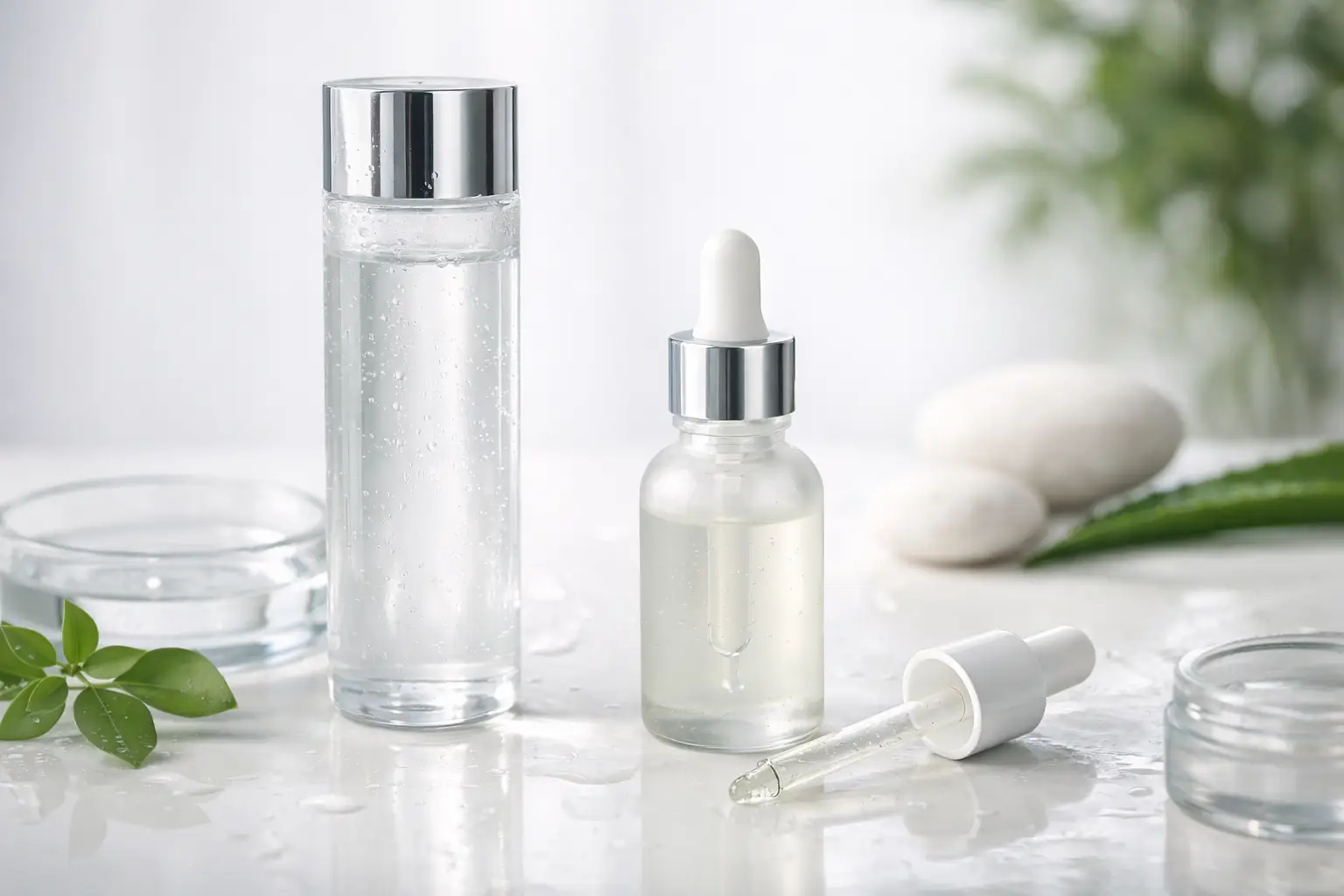
A tight feeling after cleansing, makeup that settles unevenly by afternoon, or a complexion that appears dull despite regular moisturizing can all point to the same issue: skin that needs more water support. The question of hydrating toner vs serum is often framed as a choice between two similar products. In practice, they can serve different functions, and understanding that difference makes a routine more precise rather than more complicated.
Hydration is not simply about applying the richest texture available. Healthy-looking skin depends on water content in the upper layers of the epidermis, a supportive lipid barrier, and a routine that does not repeatedly disrupt either. A toner and serum may both contribute to this goal, but their format, concentration, and role in a routine are not interchangeable.
What a Hydrating Toner Does
A hydrating toner is a lightweight, water-based step used after cleansing and before treatment products or moisturizer. Unlike traditional astringent toners, which were often designed to leave skin feeling stripped or intensely matte, modern hydrating toners are intended to replenish comfort after washing and prepare the skin for the steps that follow.
Their formulas commonly include humectants such as glycerin, hyaluronic acid, betaine, panthenol, and sodium PCA. These ingredients attract and hold water in the superficial layers of the skin. Some also include soothing components, such as allantoin, beta-glucan, or centella asiatica, which can be useful when skin feels reactive from environmental exposure, over-cleansing, or active treatments.
The value of a hydrating toner is partly functional and partly sensory. Cleansing can temporarily alter the skin’s surface environment, particularly when hot water, strong surfactants, frequent washing, or dry air are involved. Applying a gentle, water-binding toner soon afterward can reduce that immediate sense of tightness and create a more comfortable base for serum and moisturizer.
That said, a toner is not automatically necessary. If a cleanser leaves your skin calm and comfortable, and your serum and moisturizer already provide adequate hydration, omitting toner is entirely reasonable. It is a supportive step, not an obligation.
What a Hydrating Serum Does
A hydrating serum is usually more concentrated than a toner and designed to deliver a more targeted benefit. It may still be water-based, but its texture is often slightly more viscous, allowing it to carry a higher level of humectants, barrier-supportive ingredients, or treatment-focused actives.
A well-formulated hydrating serum can address more than a temporary lack of moisture. Depending on its ingredients, it may support barrier recovery, improve the appearance of fine dehydration lines, reduce visible dullness, and help the skin tolerate environmental stress more comfortably. Hyaluronic acid in multiple molecular weights, glycerin, polyglutamic acid, peptides, niacinamide, panthenol, ceramides, and ectoin are all examples of ingredients that may appear in this category.
The distinction matters because dehydrated skin often needs more than a mist of water. It benefits from ingredients that hold water within the skin and from a moisturizer that helps limit its evaporation. A serum is usually better placed than a toner to provide a sustained, concentrated layer of hydration support.
Serums can also be more versatile. Someone managing dullness, early signs of aging, or a compromised barrier may choose a serum that combines hydration with a secondary purpose, such as brightening or calming. The trade-off is that highly active formulas can be less forgiving when skin is sensitized. More ingredients and higher concentrations do not always mean better results.
Hydrating Toner vs Serum: The Core Difference
The simplest distinction is this: a hydrating toner primarily refreshes and conditions the skin after cleansing, while a hydrating serum provides a more concentrated treatment layer.
A toner tends to be thinner and faster-absorbing. It is especially appealing for those who dislike heavy layering, live in warm or humid conditions, or want to relieve post-cleanse tightness without adding weight. Applied to slightly damp skin, it can help establish a hydrated surface before the rest of the routine.
A serum is the more purposeful choice when dehydration persists through the day, when skin looks fatigued, or when barrier comfort has been affected by retinoids, exfoliating acids, travel, air conditioning, pollution, or stress. It is not merely a richer toner. Its role is to deliver a meaningful level of targeted support before moisturizer seals it in.
The two products can work well together, but only if each earns its place. Layering a toner and serum with nearly identical ingredient profiles may offer little beyond additional cost and time. By contrast, pairing a simple, soothing toner with a barrier-focused serum can be useful when skin needs comfort as well as deeper support.
How to Choose Based on Your Skin’s Current Needs
If your skin generally feels balanced but becomes momentarily tight after cleansing, a hydrating toner may be enough to restore comfort. Look for a formula without high levels of denatured alcohol, strong fragrance, or exfoliating acids if hydration is the primary objective. The goal is to reduce strain on the skin, not create a dramatic sensation.
If your skin feels dry or taut even after applying moisturizer, or if it appears crepey, lackluster, and easily irritated, a hydrating serum is likely the more valuable investment. Choose one centered on humectants and barrier-supportive ingredients, then follow with a moisturizer suited to your skin type. Hydration needs an occlusive or emollient layer above it to remain effective, especially in air-conditioned rooms or cold, dry weather.
For oily or acne-prone skin, a lightweight toner may feel more comfortable during the day, but oiliness does not rule out dehydration. In fact, skin can produce excess oil while lacking sufficient water. A non-comedogenic hydrating serum with a restrained formula can help without requiring a heavy finish.
For sensitive or recovering skin, simplicity matters most. Introducing both a new toner and a new serum at once makes it difficult to identify what is helping or causing irritation. Begin with one product, use it consistently for at least one to two weeks, and observe changes in comfort, redness, breakouts, and texture.
The Right Order Matters More Than Extra Steps
A practical routine does not need to be long. After cleansing, apply hydrating toner if you use one, then serum, then moisturizer. In the morning, finish with broad-spectrum sunscreen. This sequence moves from the lightest, most water-based texture to the more sealing layer.
There is no need to wait for every layer to dry completely. Applying a hydrating toner or serum while skin is still slightly damp can support water retention, provided the products do not pill and the skin is not irritated. Use gentle pressing motions rather than aggressive rubbing, particularly around the eyes and areas prone to redness.
If you use prescription acne treatments, retinoids, or exfoliating acids, hydration may need to become a deliberate part of the routine rather than an afterthought. On some evenings, a focused hydrating serum and moisturizer may be more beneficial than adding another active. Skin repair is often supported by restraint.
A More Useful Question Than Which Is Better
Rather than asking whether toner or serum is superior, ask what your routine is currently missing. Is your skin uncomfortable immediately after cleansing? Does it lose its fresh appearance by midday? Is it irritated by treatments that once felt manageable? Are you applying humectants but skipping the moisturizer that helps retain their benefits?
These questions lead to better choices than following a fixed number of steps. A toner may provide a refined layer of daily comfort. A serum may offer more substantial hydration and recovery support. Neither needs to be used for the sake of routine complexity.
Healthy skin rarely responds best to urgency. It responds to formulas that are compatible with its condition, applied consistently enough to assess, and adjusted thoughtfully as climate, stress, and lifestyle change. Choose the layer that gives your skin what it needs now, then allow time for steadier signs of resilience to emerge.


Leave a Reply